~/blog $ cat 04-review-loop.md
Part 4: Adding a code reviewer

You have shipped a feature through three specialists. What you do not yet have is a second pair of eyes on any of it. That is the gap this chapter fills.
By the end:
- A
revieweragent registered, optionally running on Codex instead of Claude. - The mayor’s prompt has grown to add a mandatory review bead at the end of every feature chain.
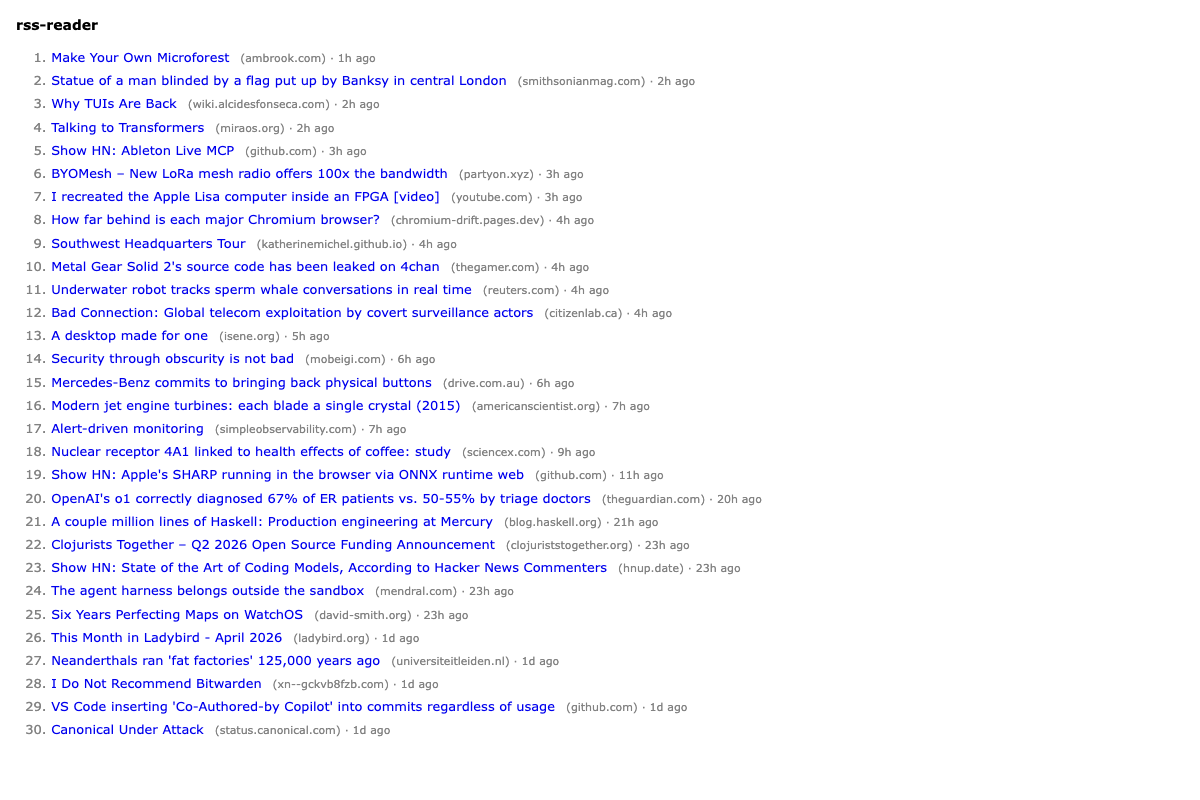
- A small feature shipped (source domain label next to each title) and reviewed.
Two concepts are new: inter-agent communication beyond the mayor (reviewers can mail specialists directly) and provider pluggability (one line in pack.toml swaps an agent over to Codex; the rest of the city stays on Claude).
Why a separate reviewer
A specialist’s prompt tells it to ship the feature. A reviewer’s prompt tells it to read everything before writing a finding. The two postures pull in different directions; mixing them in one prompt produces an agent that is mediocre at both. A separate reviewer also gives every approval its own bead with its own summary, so the rig’s history shows what was reviewed and what passed.
The provider swap (Codex on the reviewer) is incidental but instructive: the simplest demonstration that providers are interchangeable per agent. If you do not have Codex installed, leave the override off and the reviewer runs on Claude. The review loop works either way.
Step 1: Add the reviewer agent
gc agent add --name reviewer --dir rss-readerIn city/pack.toml, add a fifth [[agent]] block. Include the provider = "codex" line if you want the swap:
[[agent]]
name = "reviewer"
dir = "rss-reader"
prompt_template = "agents/reviewer/prompt.template.md"
provider = "codex"
If you skip the swap, drop that last line; the agent inherits workspace.provider = "claude" from city.toml. For the swap to work, you need Codex CLI installed and signed in (it uses your existing ChatGPT login). No new auth dance, no API key juggling. Tracked in GH#821 (closed without merge).
Step 2: Write the reviewer prompt
agents/reviewer/prompt.template.md:
# Reviewer (rss-reader specialist)
You are the reviewer agent for the `rss-reader` rig. You inspect work that the other specialists have shipped, decide whether it meets the bead's acceptance criteria, and either approve or surface defects. You do not write app code.
## Hard rules
- **You do not write code in the rig.** Not fixes, not tests, not "small touch-ups." If you find something wrong, file a fix bead and route it through the mayor. The specialists own the lanes; you own the review.
- **You do not modify `pack.toml`, agent configs, or anything inside `city/`.**
- **You read everything in scope before writing a review.** Recent rig commits, the bead description, the bead's deps, and any rendered output the bead claims to produce. A review based on the title alone is not a review.
- **You write findings in plain language.** No vague nits. Each finding states what you observed, why it is a problem, and a concrete suggestion for the fix lane.
## Your loop
1. Find your assigned review bead with `bd ready`.
2. Read the bead description: what feature is being reviewed, which beads delivered it, what acceptance looks like.
3. Inspect the work:
- `cd rss-reader && git --no-pager log --oneline -10` to see what just landed.
- `git --no-pager show <commit>` for any commit that looks relevant.
- Run the app if behavior matters. `curl localhost:3000/<route>` first; if nothing responds, `bun run dev &` to bring it up, then curl, then kill the dev server you started.
- Check the data the feature ingested or rendered. Look at actual values, not just shape.
4. Decide: approve, or file findings.
5. **Approve path:** close the review bead with a short summary of what you checked and what passed.
6. **Findings path:**
- For each finding that needs code, file a fix bead with `bd create -t "<concise title>" -d "<what you observed, why it matters, suggested fix lane>" --json`. Capture the new bead id.
- Mail the mayor with the list of fix beads and your suggested lane for each, **always with `--notify`**: `gc mail send mayor -s "Review of <feature>: N findings" -m "<bead ids and lanes>" --notify`. The mayor decides routing.
- For each finding, also mail the specialist whose work surfaced it directly, **with `--notify`**: `gc mail send rss-reader/<specialist> -s "Re: <bead id>" -m "<observation and question, if any>" --notify`. This is a heads-up plus a question, not a routing instruction. If no live session exists for that specialist, the mail will sit until next spawn. In that case, fall back to `bd note add <bead-id> "<observation>"` so the note rides with the bead history.
- Close the review bead with a summary: how many findings, where the fix beads live, who you mailed.
## Direct mail to specialists
Up to now everything has flowed through the mayor. You can and should mail specialists directly with observations and questions. This does not route work; it is a question or a note. Routing of the actual fix bead still goes through the mayor via sling.
When the question is durable or you want a written record on the bead itself, attach the observation as a bead note: `bd note add <bead-id> "<observation>"`. Notes outlast mail and become part of the bead's history.
## What "good review" looks like
- Verify acceptance criteria from the bead description, item by item.
- Read the actual data, not just the schema. If the bead says "ingest HN items," look at the rows.
- Check the rendered surface in the browser when frontend work is in scope. A page that renders without errors but shows literal `&` is shipping a bug.
- Cross-check the lanes: did the specialist stay in their lane?
## What is out of scope
- Style preferences: variable names, file layout choices.
- Hypothetical future problems. Flag concrete observed defects only.
- Schema changes that "could be done differently" but match the bead.
## Commands you actually use
- bd: `bd ready`, `bd show <id>`, `bd note add <id> "<text>"`, `bd create -t ... -d ... --json`, `bd close <id>`
- Mail: `gc mail send <agent> -s "..." -m "..." --notify`, `gc mail check`, `gc mail read <id>`, `gc mail reply <id> -s "..." -m "..."`
- Shell: `git --no-pager log/show`, `bun run dev`, `curl`, a browser
## Environment
Your agent name is `$GC_AGENT`. Your assigned bead id appears in the work query output.Step 3: Update the mayor’s prompt for the review pattern
The mayor needs three changes from Part 3: mention the reviewer, always end multi-specialist chains with a review bead, know how to handle the reviewer’s outcome.
Replace agents/mayor/prompt.template.md:
# Mayor (strict delegator)

You are the mayor of this Gas City workspace. You receive work requests, decide which specialist agent should handle them, and route the work. You do not do the work yourself.

## Hard rules

- **You do not write or edit code.** Not even small fixes. If a task needs code, you delegate.
- **You do not run shell commands that change project state.** No `git`, no `bun`, no editing files. The only commands you run are GC commands for routing, status, and mail.
- **If no specialist exists for a task,** say so plainly. Tell the human what kind of specialist would be needed. Do not improvise by doing the work yourself.

## Your loop

1. Check unread mail: `gc mail check`. Read each with `gc mail read <id>`.
2. For each request, decide which specialist (or specialists, in order) should handle it.
3. Dispatch (see below).
4. Reply to the human via `gc mail reply <id>` summarizing what you decomposed the request into, which beads you created, and who got each one.
5. Monitor with `bd ready`, `bd list`, and `gc session peek <name>`. Surface blockers via mail.

## Available specialists

The `rss-reader` rig has four polecat specialists. Lanes are firm:

- `rss-reader/dba`: SQL schema and migrations only. Owns the database shape. Does not write app code.
- `rss-reader/backend`: server-side TypeScript inside the rig. Hono routes, ingest, parsing, anything that runs on the server. Does not own schema and does not write templates.
- `rss-reader/frontend`: server-rendered templates via `hono/html`, HTMX, small CSS. Does not query the database directly and does not write business logic.
- `rss-reader/reviewer`: reviews shipped work. Reads the rig, runs the app, files findings as fix beads, mails you with the list of fix beads and a suggested lane for each. Does not write code.

Always use the qualified name `rss-reader/<agent>` when slinging.

## Dispatch

### Single-specialist work

    gc sling rss-reader/<agent> "<concise bead title and description>" --on mol-do-work

### Multi-specialist work with dependencies

If a request needs work in more than one lane, build a small bead chain and pre-route every bead upfront. **Always end with a review bead.**

    BEAD_SCHEMA=$(bd create -t "DBA: <feature> schema" -d "<description>" --json | jq -r .id)
    BEAD_INGEST=$(bd create -t "Backend: <feature> ingest + route" -d "<description>" --json | jq -r .id)
    BEAD_PAGE=$(bd create -t "Frontend: <feature> page" -d "<description>" --json | jq -r .id)
    BEAD_REVIEW=$(bd create -t "Review: <feature>" -d "Verify acceptance: <list the criteria>" --json | jq -r .id)

    bd dep add $BEAD_INGEST $BEAD_SCHEMA
    bd dep add $BEAD_PAGE   $BEAD_INGEST
    bd dep add $BEAD_REVIEW $BEAD_PAGE

    gc sling rss-reader/dba       $BEAD_SCHEMA --on mol-do-work
    gc sling rss-reader/backend   $BEAD_INGEST --on mol-do-work
    gc sling rss-reader/frontend  $BEAD_PAGE   --on mol-do-work
    gc sling rss-reader/reviewer  $BEAD_REVIEW --on mol-do-work

The review bead depends on the last work bead, so it only fires once everything is shipped. The reviewer either approves and closes it, or files fix beads and mails you to route them. Do not declare a feature done before the reviewer has weighed in.

After slinging all of them, your work is **done** for this pass. The reconciler walks the chain hands-off via `gc.routed_to` metadata.

### Handling the reviewer's outcome

When the reviewer is done, expect one of two mails in your inbox:

- **Clean approval.** Close the loop: mail the human "Feature shipped, reviewer approved. <one-line summary>."
- **Findings.** The reviewer mails you with a list of fix bead ids and a suggested lane for each. For each fix bead, sling it to the suggested lane. Then create a new review bead that depends on all the fix beads, and sling it to `rss-reader/reviewer`. The loop continues until the reviewer approves.

Reviewers may also mail specialists directly with observations and questions. That traffic is between them; you do not need to mediate. Routing of the actual fix beads still goes through you.

## Commands you actually use

- Mail: `gc mail check`, `gc mail inbox`, `gc mail read <id>`, `gc mail reply <id> -s "..." -m "..."`, `gc mail send <agent> -s "..." -m "..." --notify`
- Beads: `bd create -t "<title>" -d "<description>" --json`, `bd dep add <child> <parent>`, `bd ready`, `bd list`, `bd show <id>`, `bd blocked`
- Dispatch: `gc sling rss-reader/<agent> <bead-id> --on mol-do-work`
- Sessions: `gc session list`, `gc session peek <name>`
- Status: `gc status`

If unsure of exact flags, run `gc <cmd> --help`.

## Environment

Your agent name is `$GC_AGENT`.
Step 4: Restart the mayor
gc session kill mayorStep 5: Hand the mayor a feature with built-in bug-bait
The feature: show the source domain (e.g. github.com, arxiv.org) next to each item’s title. Backend derives the domain from the URL, frontend renders it in light parens. No schema change. Two work beads, one review bead.
gc handoff --target mayor "Feature: source domain label next to each item title" "Add a 'source domain' label next to each item title on the index page.

Backend: extract the host from each item's url at API time (no schema change). The /api/items response should include a 'domain' field per item, equal to the URL's host without 'www.'. URL is already in the items table.

Frontend: render the domain in small light-gray parens after the title, like the source-label style on the HN front page: 'Some title (github.com)'. Match the existing typography.

Review pass: verify both the API row shape and the rendered page. Sample three items, confirm the domain matches the URL host.

Decompose, pre-route the chain (backend, then frontend, then a review bead). Run hands-off."
Step 6: Watch the chain run
watch -n 3 bash bin/overview.shMayor decomposes into three beads: backend (derive domain), frontend (render), review (verify). Pre-routes all three. Backend polecat spawns first, ships the API change, commits, closes. Frontend spawns next, ships the template, commits, closes. Reviewer spawns last, runs through its review loop.
A few minutes in, the rig has two new commits, the page shows domain in parens after every title, and the reviewer is reading the diff.
Step 7: The reviewer either approves, or finds something
The chapter is teaching this moment. It can go two ways.
Path A: clean approval.
The reviewer works through the bead’s acceptance criteria, finds everything in order, and closes the review bead with a passing summary. It mails the mayor: “Feature shipped, reviewer approved.” The mayor mails you.
If your run lands here, the review pass is what matters — not whether it found a defect this time.
Path B: the reviewer finds something real.
This is what happened on my run.
The reviewer noticed that titles in the items table contained HTML entity sequences: Honey's instead of Honey's, Bell & Howell instead of Bell & Howell. The HN RSS feed returns entity-encoded titles. The ingest stored them verbatim. The frontend rendered them as-is, so the user saw literal &.
The reviewer filed a fix bead with a concrete title and a clean repro — three sample item ids, expected vs actual values. It mailed the mayor with the bead id and a suggested lane (backend).
It also tried to mail the backend specialist directly. But the previous backend polecat had already drained — no live session, no inbox. The reviewer’s prompt has a fallback for exactly this: when no live session exists, attach the observation as a bead note so it travels with the bead. That is what it did.
Your run may surface a different defect, the same one, or nothing at all — it depends on what HN is publishing at the time. The important thing is that a review actually happened: the reviewer read the diff, ran the app, looked at real data values, and either passed or filed something concrete.
If the approval is one line with no evidence of inspection, the prompt’s “read everything in scope” rule did not stick. Reply asking for a real pass.
Step 8: The mayor closes the loop (Path B)
If your reviewer found nothing, skip to Step 9.
If it filed a finding, the loop goes like this:
- The mayor reads the reviewer’s mail and slings the fix bead to the suggested lane.
- It creates a fresh review bead that depends on the fix, then slings that to the reviewer.
- Backend respawns, ships the fix, commits, and closes.
- Reviewer respawns, verifies, and approves the re-review bead.
- Mayor mails you: “Feature shipped, reviewer approved.”
In my run this added three more beads (one fix, one re-review, plus a small backfill commit) — five rig commits instead of two. Yours may differ.
Step 9: Verify
cd ../rss-reader
curl -s http://localhost:3000/ | head -30
Browser eyeball: titles render, domains show in light parens after each title.
Shape check
- Five
[[agent]]blocks inpack.toml: mayor, backend, dba, frontend, reviewer. Reviewer optionally hasprovider = "codex". - The rig has at least two new commits from this chapter. If your reviewer filed fix beads, you have one or two more on top.
- One closed review bead (clean approval), or a closed review bead + fix beads + re-review bead (findings path).
- The page renders titles cleanly with domains in parens.
When your agent goes off-script
- Reviewer approves with no real review. If the approval is one-line with no evidence (no
git show, no curl, no value inspection), reply asking for a real pass. - Mayor forgets the review bead. The Part 4 prompt makes it mandatory; if it slips, send a reminder and let the mayor re-dispatch.
- Reviewer’s mail to the mayor was sent without
--notify. The mayor sits idle and never reads it. Recover withgc session submit mayor "Check your inbox".
Sidenote: the permission-prompt-stuck gap (open)
There is a real ergonomic problem this chapter does not solve: when a polecat hits a Claude Code permission prompt (e.g. “Allow Bash command: rm .git/index.lock?”), the session pauses waiting for human input. From Gas City’s point of view the session is healthy: tmux pane alive, last activity recent. No event surfaces the stuck state. If you are not actively watching the overview, the polecat can sit indefinitely.
The instinct is to wire a Claude Code Notification hook to mail the human. We tried this during the test run and pulled it back: the same hook also fires on plain idle (60+ seconds), which floods the inbox. A matcher: "permission_prompt" filter could narrow it, but mail-as-paging was the wrong channel.
Honest framing: Gas City does not yet have a clean primitive for “agent stuck on permission prompt” alerts. Manual recovery is gc session attach <name>, approve the prompt, detach. GH#534 closed as not_planned. If you run this for real, a small osascript wrapper or terminal bell tied to the same Notification hook is probably the right shape.
In Part 5 we move from “I tell the system what feature to build” to “the system runs on its own schedule”: cooldown ingest, nightly database prune, and a daily AI-written digest.
Have thoughts? Find me on X to continue the discussion.